
India is on course to re-register nearly 300 foreign-owned vessels under the Indian flag by 2030, unlocking cabotage access, tonnage-tax benefits, and government cargo preference for domestic shipowners. Converting a foreign vessel means deleting it from its existing foreign registry and re-registering it in India under the Merchant Shipping Act, 2025 (MS Act 2025). The entire regime is administered by the Directorate General of Maritime Administration (DGMA) - the successor authority to the erstwhile Directorate General of Shipping - working through the Mercantile Marine Departments (MMDs) and the Indian Register of Shipping (IRS).
At Legal Babu, we manage the end-to-end flagging process on behalf of shipowners, charterers, and financiers - from name reservation to the issuance of the Certificate of Indian Registry.
What Does It Mean to Convert a Foreign Vessel to an Indian Flag?
To convert a foreign vessel to an Indian flag easily means to legally delete the vessel from its existing (foreign) registry and re-register it in India, so that it flies the Indian tricolour and enjoys the full protection of Indian maritime law. Once the foreign flag to Indian flag conversion is complete, the vessel becomes an Indian ship under Section 3 of the Merchant Shipping Act, 2025, and can lawfully engage in coastal trade, international voyages, and cabotage-reserved operations along the Indian coast.
The ship flag change process in India is administered by the Directorate General of Maritime Administration (DGMA) through the Mercantile Marine Department (MMD). Physical surveys and technical verification are typically carried out by the Indian Register of Shipping (IRS) or another Recognised Organisation (RO) when the vessel is at a foreign location.
Why Convert a Foreign Vessel to an Indian Flag? Top 7 Benefits
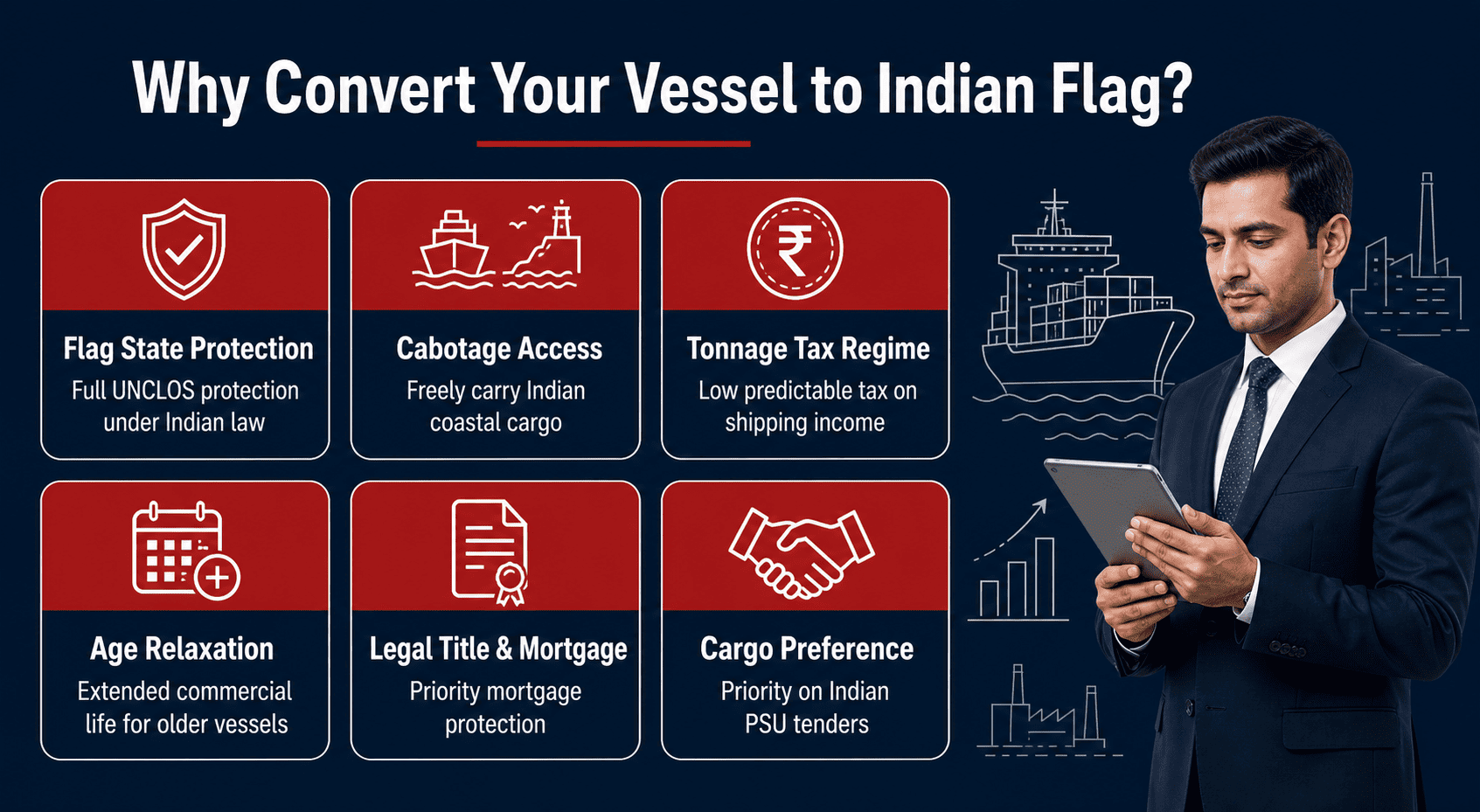
Choosing to register a vessel under the Indian flag provides a combination of legal, commercial, and strategic benefits.
|
Benefit |
Why It Matters |
|
Flag State Protection under UNCLOS |
Full protection of the Indian State on the high seas |
|
Access to Cabotage & Coastal Trade |
Only Indian-flag ships can freely carry domestic coastal cargo |
|
Tonnage Tax Regime |
Predictable, low-effective tax rate for shipping income |
|
Age-Limit Relaxation (up to 10 years extra) |
Older vessels get extended commercial life under the Indian flag |
|
Clear Legal Title & Mortgage Rights |
Indian registry recognises mortgages with priority protection |
|
Government Cargo Preference (Right of First Refusal) |
Indian-flag vessels get priority on PSU-tendered cargoes |
|
Access to Indian Ship Financing |
Easier lending, insurance, and P&I support from Indian institutions |
These benefits explain why global players are increasingly opting for the foreign flag to Indian flag conversion route rather than continuing under flags of convenience.
Who Is Eligible to Own an Indian-Flag Vessel?
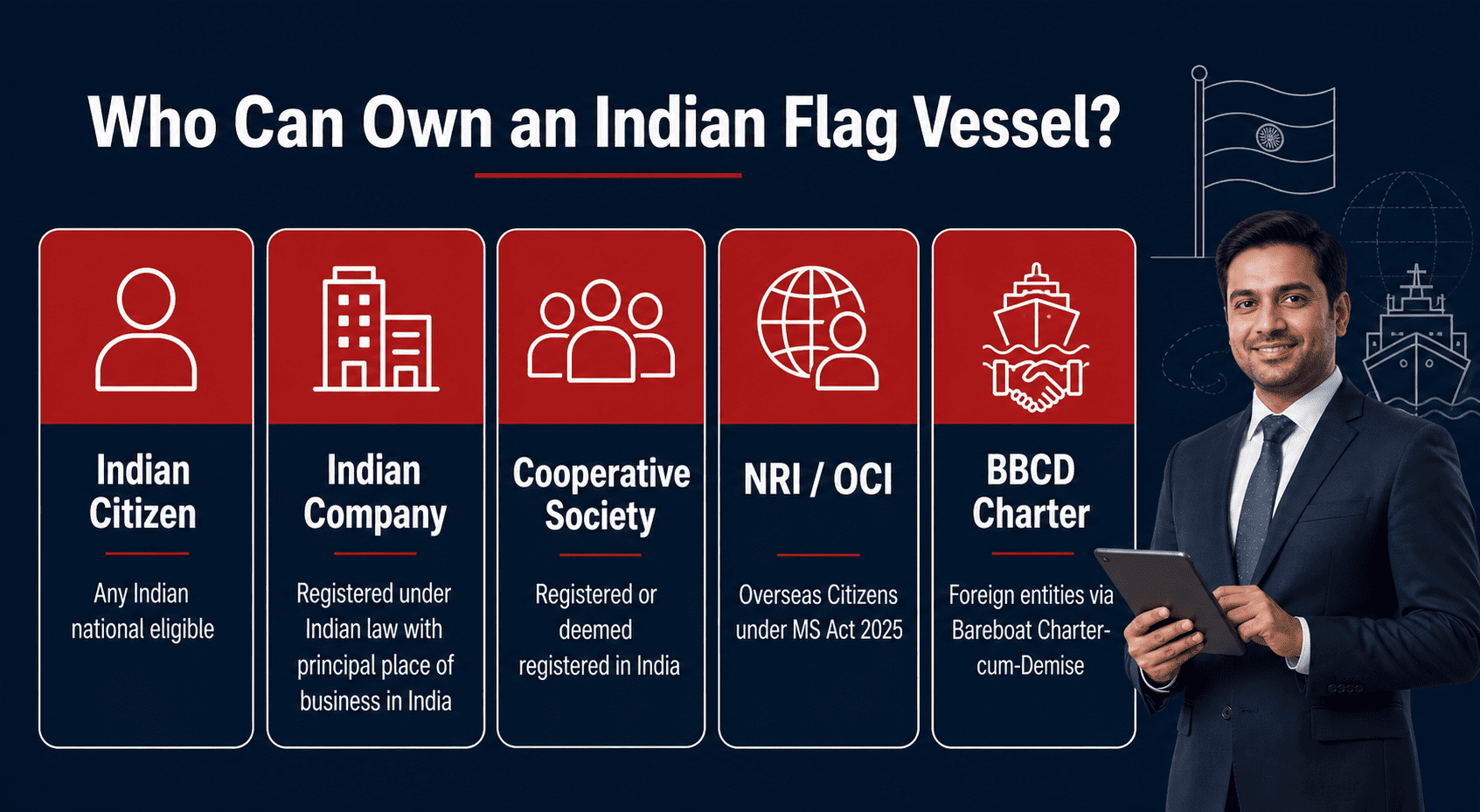
Under the Merchant Shipping Act, 2025, the following persons/entities can own and register a vessel under the Indian flag:
-
A citizen of India;
-
A company registered under Indian company law with its principal place of business in India;
-
A cooperative society registered/deemed registered in India;
-
A body corporate established by or under a Central/State Act;
-
NRIs and OCIs, the new Act clarifies flexible ownership provisions;
-
Foreign-owned entities operating under a Bareboat Charter-cum-Demise (BBCD) arrangement with an Indian charterer.
This liberalised eligibility has been a big driver behind the surge in reflag vessel to India activity.
Process to Convert a Foreign Vessel to an Indian Flag
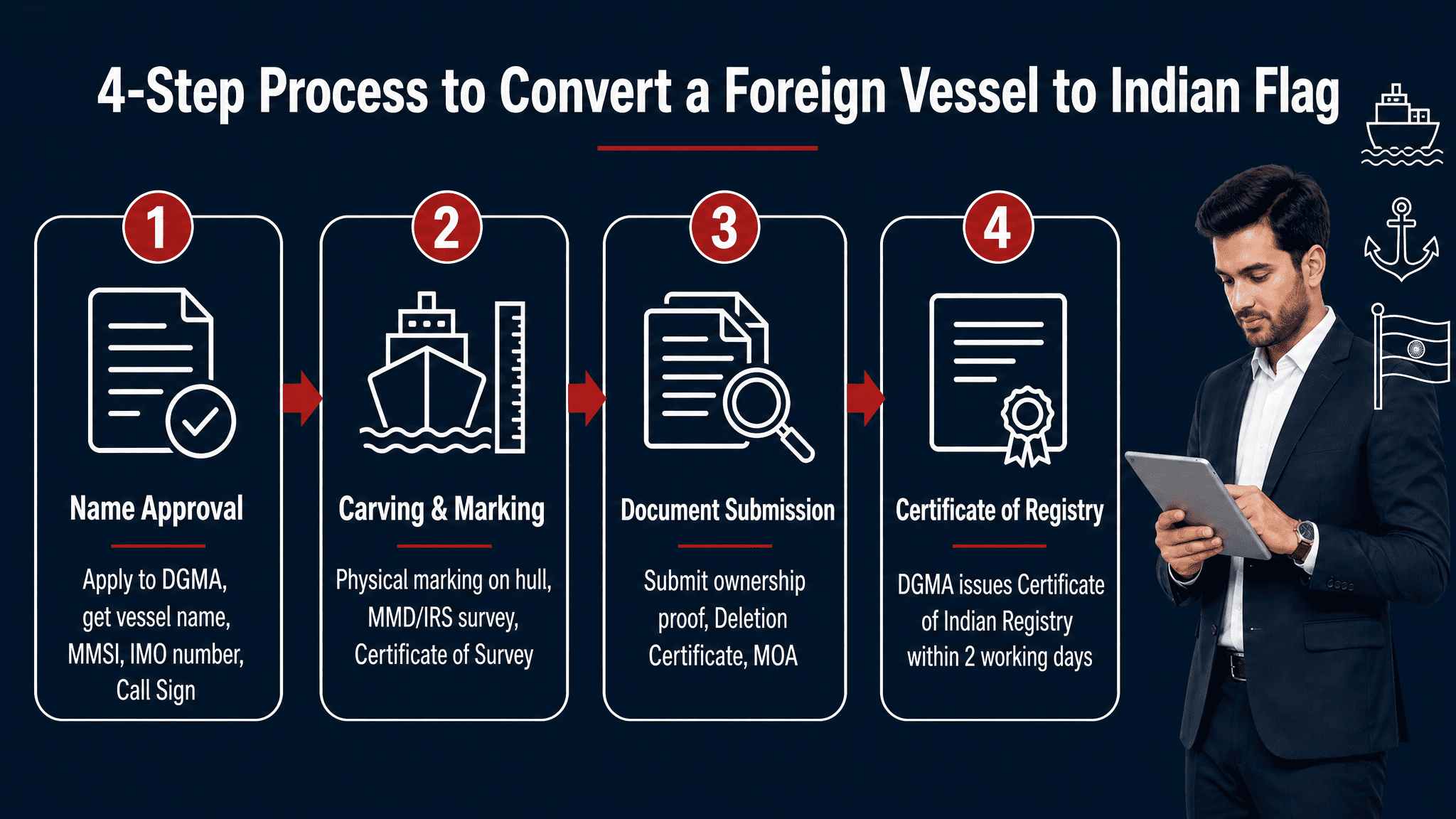
The DGMA framework prescribes a fully digital, four-stage process:
Stage 1 - Name Approval & Identifier Allotment
The application for name reservation is filed with the DGMA. Three preferred names are submitted in order of preference, along with the prescribed government fee. Once approved, the name and unique identifier are valid for 2 years, within which registration must be completed.
Stage 2 - Carving, Marking & Survey
The Registrar issues the Carving & Marking Note, following which the vessel's name, official number, port of registry, net tonnage, and load line are permanently carved and painted on the hull. A statutory survey is conducted by IRS (if the vessel is abroad) or by the jurisdictional MMD (if in an Indian port). Where required, DGMA may issue a Provisional Certificate of Indian Registry valid for up to 6 months to permit the ship to sail to India.
Stage 3 - Submission of Documents & Declarations
The full documentary package is submitted to DGMA - including ownership proof, the Deletion Certificate from the previous flag, technical certificates from class, and statutory declarations (including the No-Sanctions undertaking and Beneficial Ownership declaration).
Stage 4 - Issuance of the Certificate of Registration
Once DGMA verifies compliance, the permanent Certificate of Indian Registry is issued. In practice, this is issued within 2 working days of complete documentation being placed on record.
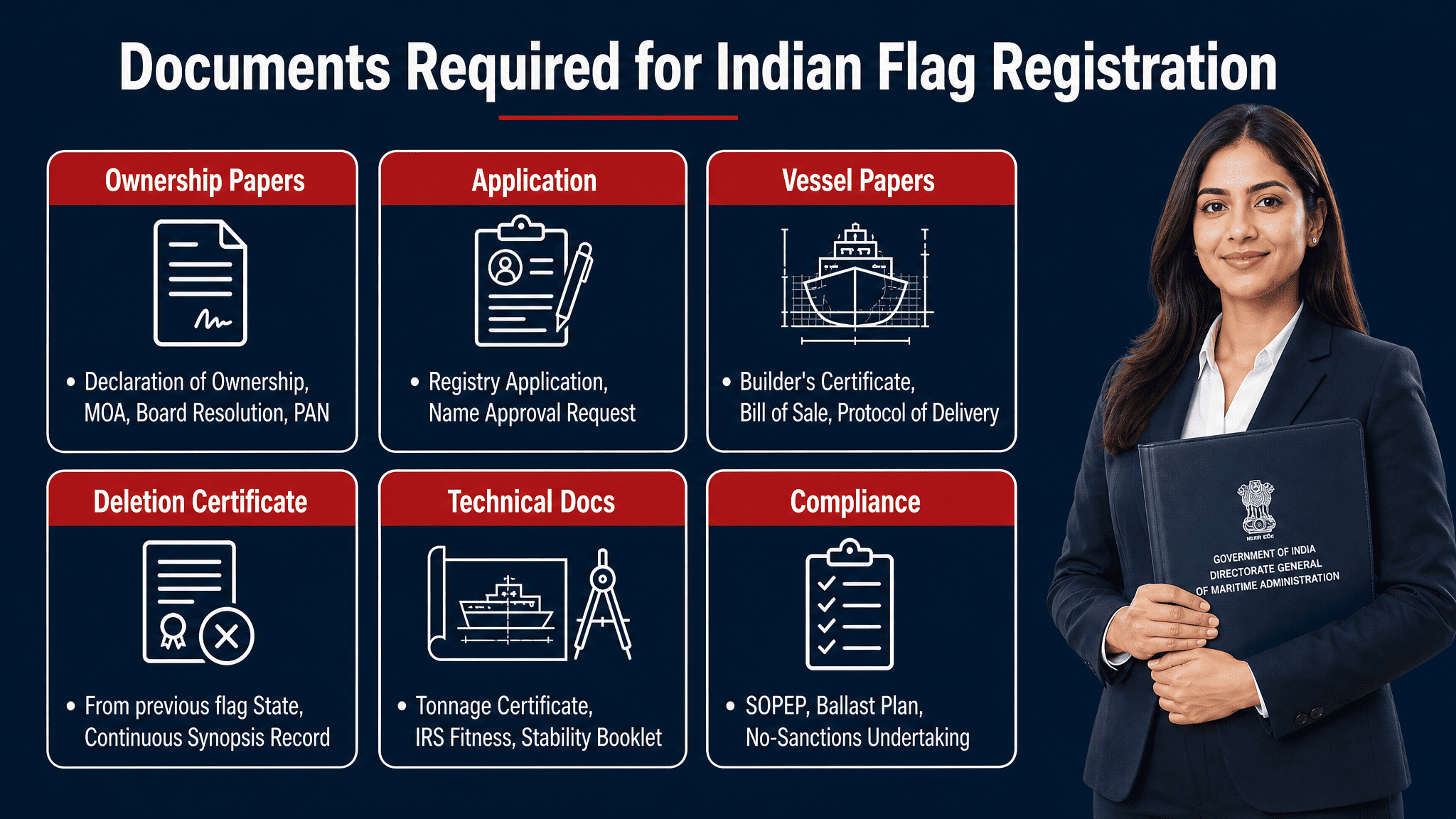
Documents Required (Complete Checklist)
Below is the master checklist you should keep ready before initiating the foreign flag to Indian flag conversion.
|
Category |
Key Documents |
|
Ownership Proof |
Application for Registry, Declaration of Ownership, Memorandum of Association, Board Resolution, PAN, GST |
|
Vessel Papers |
Builder's Certificate / Bill of Sale, Protocol of Delivery & Acceptance |
|
Previous Registry |
Deletion Certificate from the foreign flag, Continuous Synopsis Record (CSR), Class Transfer Certificate |
|
Technical |
Tonnage Certificate, IRS Fitness Certificate, Stability Booklet, General Arrangement Plan |
|
Survey |
Carving & Marking Note |
|
Safety & Environment |
SOPEP, Ballast Water Management Plan, NOx Technical File, ISM Document of Compliance, MLC Certificate |
|
Compliance Declarations |
No-Sanctions Undertaking, Beneficial Ownership Declaration |
Every photocopy must be signed and stamped by the authorised person of the company - unattested photocopies are rejected by MMD.
Provisional vs Permanent Certificate of Registry
Where the Deletion Certificate from the previous flag is delayed, DGMA can issue a Provisional Certificate (Form 10) so the vessel is not grounded.
|
Feature |
Provisional Certificate (Form 10) |
Permanent Certificate (Form 9) |
|
Validity |
6 months |
Indefinite (subject to renewal cycles) |
|
When Issued |
Deletion Certificate pending |
All documents complete |
|
Issuing Authority |
Indian Consular Officer / MMD / IRS |
Registrar of Indian Ships (MMD) |
|
Usage |
Allows immediate commercial operation |
Full Indian-flag status |
|
Convertibility |
Must be exchanged for Form 9 |
Final document |
Fees for Converting a Foreign Vessel to an Indian Flag
The DGMA vessel registration fees are transparent and reasonable.
|
Service |
Fee (INR) |
|
Name & Identifier Approval (First) |
₹10,000 |
|
Name Renewal |
₹5,000 |
|
Registration (New / Second-hand / BBCD) |
₹2.50 per GT (Min ₹5,000 / Max ₹2,00,000) |
|
Transfer of Ownership |
₹5,000 |
|
Change of Port of Registry |
₹5,000 |
|
Change of Vessel Name |
₹5,000 |
|
Creation of Mortgage |
₹0.25 per ₹1,000 of mortgage value |
|
Discharge of Mortgage |
NIL |
|
Duplicate Certificate (Loss) |
₹5,000 |
|
Closure of Registration |
₹5,000 |
The maximum registration fee is capped at ₹2,00,000 - making India one of the most cost-competitive flag States in the world.
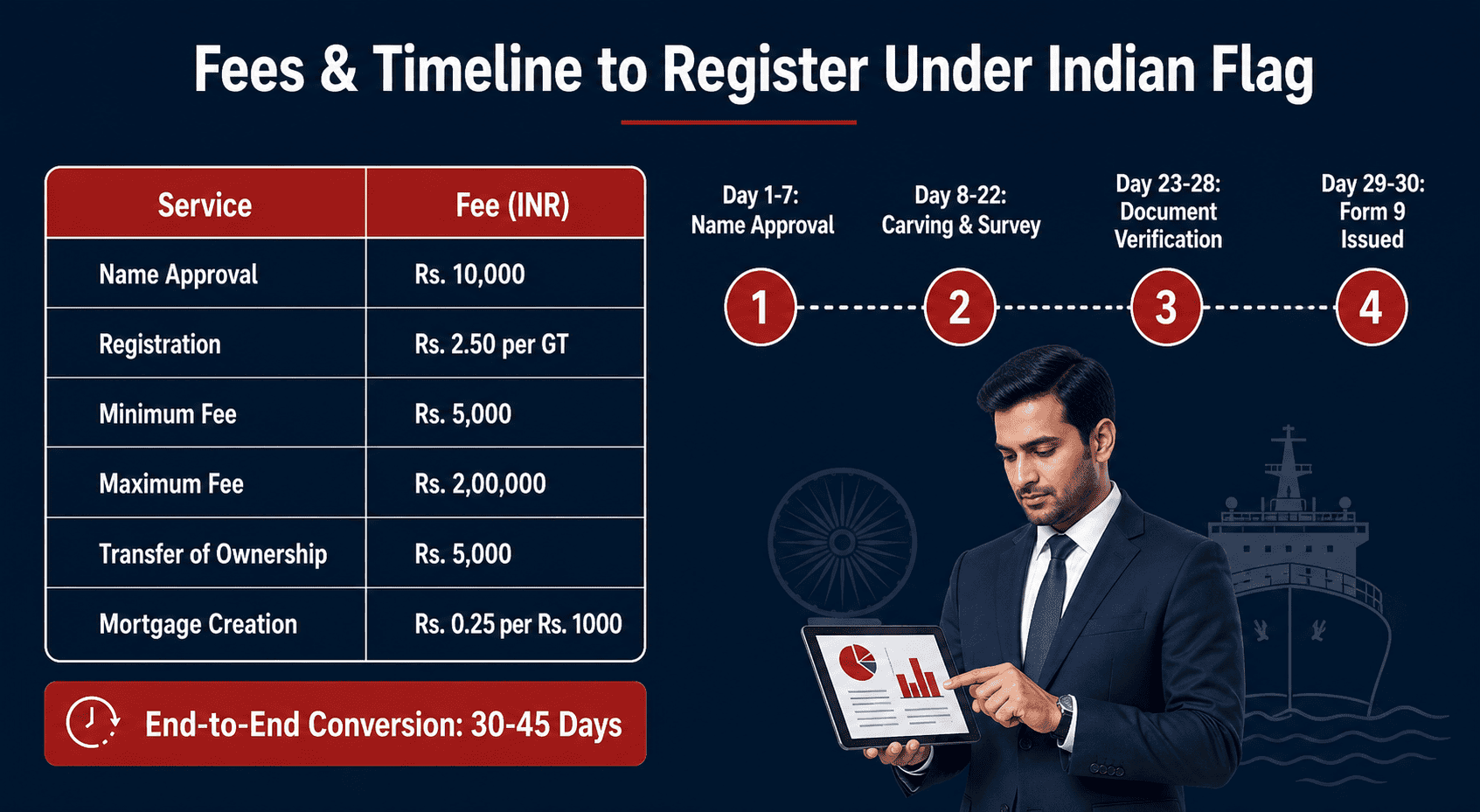
Note: These estimates can vary based on the time and process
Timelines & Processing Duration
|
Stage |
Approx. Duration |
|
Name Approval |
3-7 working days |
|
Carving, Marking & Survey |
7-15 days (depends on location) |
|
Document Verification |
2 working days |
|
Provisional Certificate Issuance |
Same day (if applicable) |
|
Final Certificate of Registry (Form 9) |
2 working days post-complete submission |
|
End-to-End Conversion |
~30-45 days on average |
Timelines begin only when the application is complete and all fees are paid.
Post-Registration Compliance for Indian-Flag Vessels
Once you register a vessel under the Indian flag, ongoing compliance kicks in:
-
Crew Nationality Rules - Indian-flag ships must primarily employ Indian seafarers holding valid CDCs and INDoS numbers.
-
Flag State Inspections (FSI) - Periodic inspections by MMD as per DGMA M.S. Notice No. 4 of 2017.
-
Statutory Certificates - SMC, ISSC, MLC, and Class certificates must remain valid.
-
Radio Reprogramming - AIS, EPIRB, SSAS, LRIT, and VDR must reflect Indian identifiers.
-
LSA/FFA Re-marking - Lifeboats, life rafts, and life buoys must display the Indian port of registry.
-
Cabotage Compliance - Only Indian-flag vessels can freely lift coastal cargo without a chartering licence.
Ships in continuous Indian waters for more than 30 days must also undergo immigration and customs conversion.
Common Challenges & How to Avoid Them
The foreign flag to Indian flag conversion is straightforward on paper, but many owners stumble on:
-
Delayed Deletion Certificate from the previous flag → Solution: apply for the Indian Provisional Certificate (Form 10).
-
Unattested photocopies → MMD rejects them outright; every page must be stamped and signed.
-
Missing IRS Fitness Certificate → Engage IRS early during the newbuild or MOA stage.
-
Age-related technical clearance for vessels 25+ years → Prepare a comprehensive condition report.
-
Mismatch between Bill of Sale and Protocol of Delivery → Ensure both documents are notarised and consistent.
A qualified maritime consultancy, such as Legal Babu, can pre-audit these documents and prevent last-minute delays.
Role of Legal Babu in Foreign-to-Indian Vessel Conversion
Legal Babu specialises in DGMA vessel registration, chartering licences, RPSL, and maritime compliance. Our team helps you to:
-
Structure ownership in line with the Merchant Shipping Act, 2025
-
File Form 15 name application and reserve identifiers
-
Coordinate with the IRS for out-of-India surveys
-
Compile a court-ready set of documents for MMD submission
-
Advice on chartering licences for foreign-flagged vessels during transition
-
Ensure RPSL annual compliance for post-flagging manning
-
Support AEO registration for smoother customs handling of the reflagged vessel
Whether you own a single tug or a fleet of tankers, our end-to-end advisory ensures your ship flag change process in India is completed within statutory timelines.
Conclusion
To convert a foreign vessel to an Indian flag is no longer a bureaucratic maze - it is a well-defined, digital-first, four-step journey administered through the DGMA under the Merchant Shipping Act, 2025. With low fees, fast timelines, cabotage protection, tonnage tax benefits, and Flag State protection under UNCLOS, India offers one of the most attractive registries in the region.
If you are considering a foreign flag to Indian flag conversion, engage a specialist early, get your documentation in order, and use the guidance above as your project checklist. The Indian tricolour on your vessel is not just a symbol - it is a passport to global maritime opportunity backed by the world's fastest-growing large economy.
For personalised assistance with the Indian flagship registration process, connect with the Legal Babu team through legalbabu.com.
FAQS
FAQs About Convert a Foreign Vessel to an Indian Flag
-
What is the meaning of
It refers to the legal process of deleting a vessel from its foreign registry and registering it under Indian law so it can fly the Indian flag and be treated as an Indian ship under the Merchant Shipping Act, 2025.
- Which authority handles the Indian flagship registration process?
- Can a foreign-owned company own an Indian-flag vessel?
- How long does it take to reflag a vessel to India?
- What is the total cost to register a vessel under the Indian flag?
- Is a Deletion Certificate mandatory for a foreign-flag to Indian flag conversion?
- What is the role of the Indian Register of Shipping (IRS)?
- What documents are needed to convert a foreign vessel to an Indian flag?
- Can Legal Babu assist with the entire reflagging process?


